From data strategy to organizational design: balancing organizational development and people as success factors
Data is nothing ... but nothing is also something
After all, data is nothing. Nothing but a collection of zeros and ones ... until you do something with it! And keep repeating it, so that you get a learning and adaptive organization. Then nothing becomes something beautiful.
You need to do two things to turn your data into something: direction and get started!
First, focusing data - that is, translating it into insights and application and thus contributing to business strategy. Something that in practice sounds easier than it is. For this issue, we developed the Target to data model to get a sharp focus on where data & analytics can develop the most value.
The second thing needed to develop long-term value with data is to set up your organization to work with it successfully. Making data work permanently requires a longer-term, structural and broader approach. How to do this and where best to start are covered in this article.
Making data-driven work permanent - broader than technology
Now that most organizations are "out of the dark" when it comes to the potential of data and have the first successful pilots, the question looms of how to embed it in the organization and what is needed to do so. And not just from a technical perspective as in the early days of big data, but from a broader organizational perspective. Think of questions like:
- how to shape a data department,
- Where do I hang it in the organization,
- what kind of people do I need,
- how many people,
- what should these people be able to do?
To answer these questions, we first look at the bigger picture of the data value chain and what it requires of organizations.
The data value chain and the role of director
To permanently cash in on the mountain of gold that data seems to be, organizations must succeed in controlling the data value chain and optimizing it.
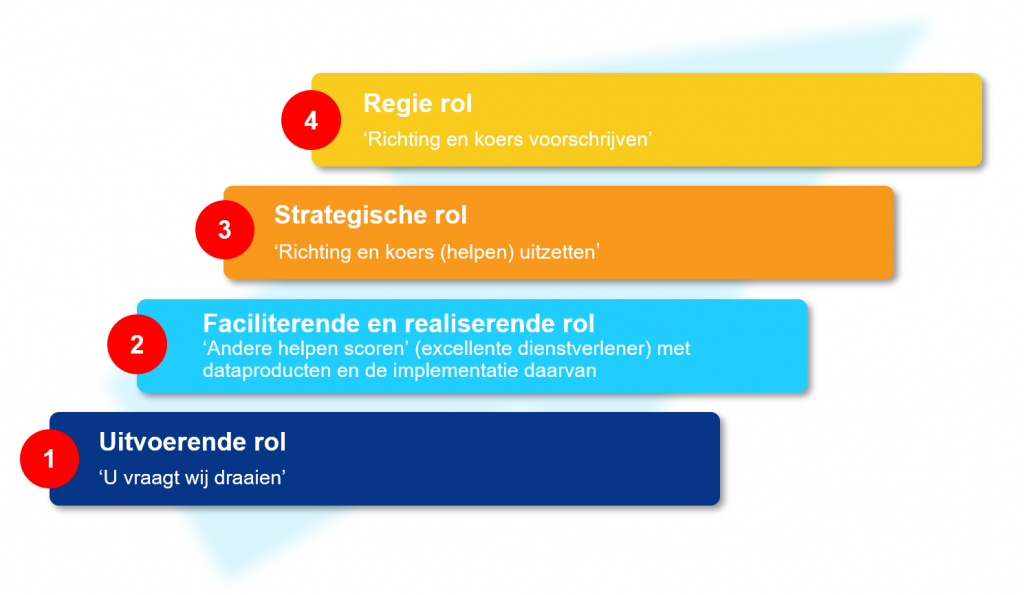
This requires mastery of all organizational aspects. Of people, organization, processes, data and systems. And where data and associated organizational entities have often been executive until now, you want to move up in maturity to strategic issues. To ultimately directing based on facts.
Organizational aspects in balance: the chain is as strong as its weakest link
As the role of data shifts from supporting to strategic or even directing, it demands that organizations develop all of these aspects in balance. You can have skilled analysts on staff, but if the business can't grasp it or apply it, it's not going to work.
You can have good data, but if your process to process it is manual, you will never develop the speed to apply this data successfully. You can have a culture where people dare to experiment and undertake. Getting it successfully into the organization only works if people are working together and not holed up in organizational silos. And the above reasoning can be applied to any imbalance in the various maturity aspects of the organization.
The combination of different levels of ambition coupled with different organizational aspects together form a powerful tool to determine ambitions and organizational impact. And thus to steer the necessary change in a focused and coherent way. Once you know which aspects you need to change and which gaps need to be closed, the next valid question is where to start.
Success starts with people! - four factors for success with the human touch
Experience shows each time that success is impossible without the human factor. This falls into four aspects:
- It begins at leadership: Board belief and sponsorship to shape the move to data-driven work
- Then the juist people coming from data to insights and understand where data can add value. So subject mature analysts and data scientists who have enough business knowledge to get to the core. You can recruit these newly or develop them with training, education and coaching from the talent already present in the organization.
- And the people who can apply the insights - the business - and can increase value by asking the right follow-up questions. This very part is often still underestimated. But just as analysts need to be able to bridge the gap to business issues, business people also need to evolve to get a feel for the potential and application of data and insights. Calling out of ignorance that you "want to know everything" when asked by a BI department what you would like to know in order to do your job better is not going to help....
- And last but not least ... collaboration: connecting the previous factors into an organizational form and culture that ensures that the organization will become learning and adaptive. In order to be successful in the increasingly challenging landscape in which the company operates.
The path to turning nothing into something beautiful - Data Strategy
For organizations, there is indeed a clear path to follow to turn nothing into something and make data work. We are happy to help take the first steps in this. In the form of developing a data strategy or an assessment of existing situations and strategies. And of course by supporting it with the right people, because as mentioned, that is one of the most important sources of success. From thinking to doing with each other!
In addition to the people side, organizational design and creating the right culture also play an important role. If you want to read more about this check out our articles on the subject.
Culture, the true key to success in data-driven work?
Implementing data strategy successfully: the organizational setup